Cannabis is a plant that has been used for medical purposes for thousands of years. There has been documented proof of the efficacy of medical cannabis. People use medical cannabis to help with pain, sleep problems, nausea, anxiety and to treat symptoms from serious health conditions including cancer, HIV, and epilepsy. Cannabis is effective for many people and can be a safe option when used as a medicine.
Qualifying conditions
Hawaii state law recognizes medical cannabis use. Qualifying conditions can be determined by your primary care physician (PCP), a treating physician, and hospice care. Please contact the Registry program to find out more or call (808)733-2177 Monday-Friday 8:30AM-3:30PM (HST). If the OMCCR staff is unable to answer your call email [email protected]
Frequently Asked Questions
- How do I become a medical cannabis patient?
Talk with your doctor or Advanced Practice Registered Nurse (APRN) Cannabis can interact with some prescription medications. Be sure to ask your provider if your current prescriptions, over-the-counter medications or supplements will interact with medical cannabis. Go to our Registry section for further information about becoming a medical cannabis patient. - What can I expect to experience in a medical cannabis dispensary?
Unlike a pharmacy where patients only receive precisely what is prescribed, a dispensary offers an array of products that vary in potencies and delivery methods. In our state the retail staff or budtenders are required to undergo a background check and are registered with the OMCCR. Budtenders are not treating physicians. Patients should work with providers to understand the proper dosage and appropriate medical cannabis form and dosage they need. Budtenders will be able to provide you with basic product information, but it’s important to be an informed patient. Learn how to read the product label. - What is the difference between the medical cannabis in a dispensary and the cannabis grown in my neighborhood?
Dispensary medical cannabis has been tested for quality assurances and is required to be properly labeled. Our state allows both registered patients and caregivers to grow medical cannabis. Many patients cultivate their own medicine. Many caregivers cultivate medical cannabis for patients. Home growing can produce quality medicine. It’s important for those new to growing medical cannabis to seek guidance to ensure healthy plants which in turn, yield good medicine. Understanding the dangers of pesticides, proper drying techniques, and more are crucial for safe cannabis medicine. - What is the difference between cannabis and medical cannabis?
It is the same plant, but the consumer’s intentions with the cannabis plant are arguably different. Medical cannabis is used for symptom relief for patients with rare and common chronic illnesses. The cannabis plant is also used for the intoxicating effects by individuals who are not seeking symptom relief.
- What is the difference between the cannabis plant and the hemp plant?
The cannabis plant and the hemp plant are same species of plant, but have been separated by legal definitions based on THC concentration.
The hemp plant has traditionally been bred for industrial applications. Industrial hemp often grows longer and taller than the traditional cannabis plant. The long hemp threads are called ‘herd’. Herd has lower THC value. Industrial applications for hemp include animal bedding and feed, paper, building materials such as hempcrete, tents, rope, twine, and biofuel. Many hemp varietals are now bred for cannabinoids other than THC, such as CBD and CBG, and may look like THC-dominant cultivars.
The traditional cannabis plant has been manipulated and bred to produce higher amounts of THC into a smokeable flower form. - What is THC?
THC is tetrahydrocannabinol and is also known as Delta-9. It is a naturally occurring psychoactive compound, a chemical found in the cannabis plant. There are hundreds of compounds in the cannabis plant. It is the most widely researched psychoactive intoxicating compound.
There are other mild intoxicating compounds, such as CBG and CBN, but they are considered far less severe in effect. THC is an analgesic with well-known pain-relieving properties. It has been studied for increasing appetite, relevant to patients who experience nausea induced chemotherapy and HIV cachexia, and is recognized for its potential to release muscle spasms.
When not used responsible or in high doses it can elicit unwanted side effects that include dry mouth, red eyes, anxiety, paranoia, and even tachycardia, which is a high heart rate that beats more quickly than usual. It also affects blood pressure. It is the chemical compound known to activate receptors in your brain thereby causing the sensation of being ‘high’. It was used in ancient societies for various spiritual practices. - What is the endocannabinoid system?
The endocannabinoid system is a master regulatory system that creates homeostasis for all physiological processes. All vertebrate species produce endocannabinoids.
Endocannabinoids were first recognized in 1992. There are hundreds of endocannabinoids. Some of the chemicals or endocannabinoids produced in the human body are similar to the THC and CBD that are found in the cannabis plant. - What is CBD?
Cannabidiol, commonly known as CBD, is a compound found in the cannabis plant. CBD does not cause intoxication like THC, but it may cause drowsiness and interact with prescription or over-the-counter medications.
CBD is being studied for potential therapeutic uses, including anxiety, sleep, pain, inflammation, and certain seizure disorders. However, more research is needed to better understand its benefits, risks, appropriate dosing, and long-term effects.
Not all CBD products are equal. They are often marketed as safe or natural, but quality, strength, ingredients, and labeling accuracy can vary widely.
Because of these uncertainties, CBD use is not recommended during pregnancy or breastfeeding. - Is cannabis legal in Hawai’i?
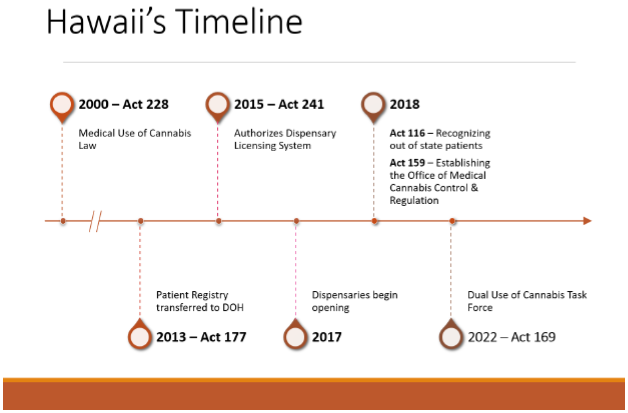
- What is the difference between cannabis and alcohol?
Cannabis:
All cannabis is illegal under federal law. Medical cannabis use is legal in 40 states, and 24 states have legalized its use for recreational purposes for citizens aged 21 and older. Cannabis is the most common federally illegal drug.
Cannabis can provide symptom relief. There are four Food and Drug Administration (FDA) approved medicines that use cannabis including Epidiolex for seizures and three THC medications (Marinol, Syndros, Cesamet) for nausea due to chemotherapy and AIDS.
There are no known deaths directly related to the sole and direct consumption of cannabis.Alcohol:
Since 1988 the federal drinking age has been age 21. Evidence suggests this has reduced alcohol-related deaths and injuries. Prohibition of alcohol use, consumption, business, and transportation was from 1920-1933. This ban was repealed by the 21st amendment.
According to the U.S. Centers for Disease Control and Prevention (CDC) alcohol is the most common substance used among people age 12 and older. In the U.S., excessive use of alcohol is a leading cause of preventable death (178,000).
Both alcohol and cannabis can be addictive substances. - Can I travel with medical cannabis?
See TSA guidelines